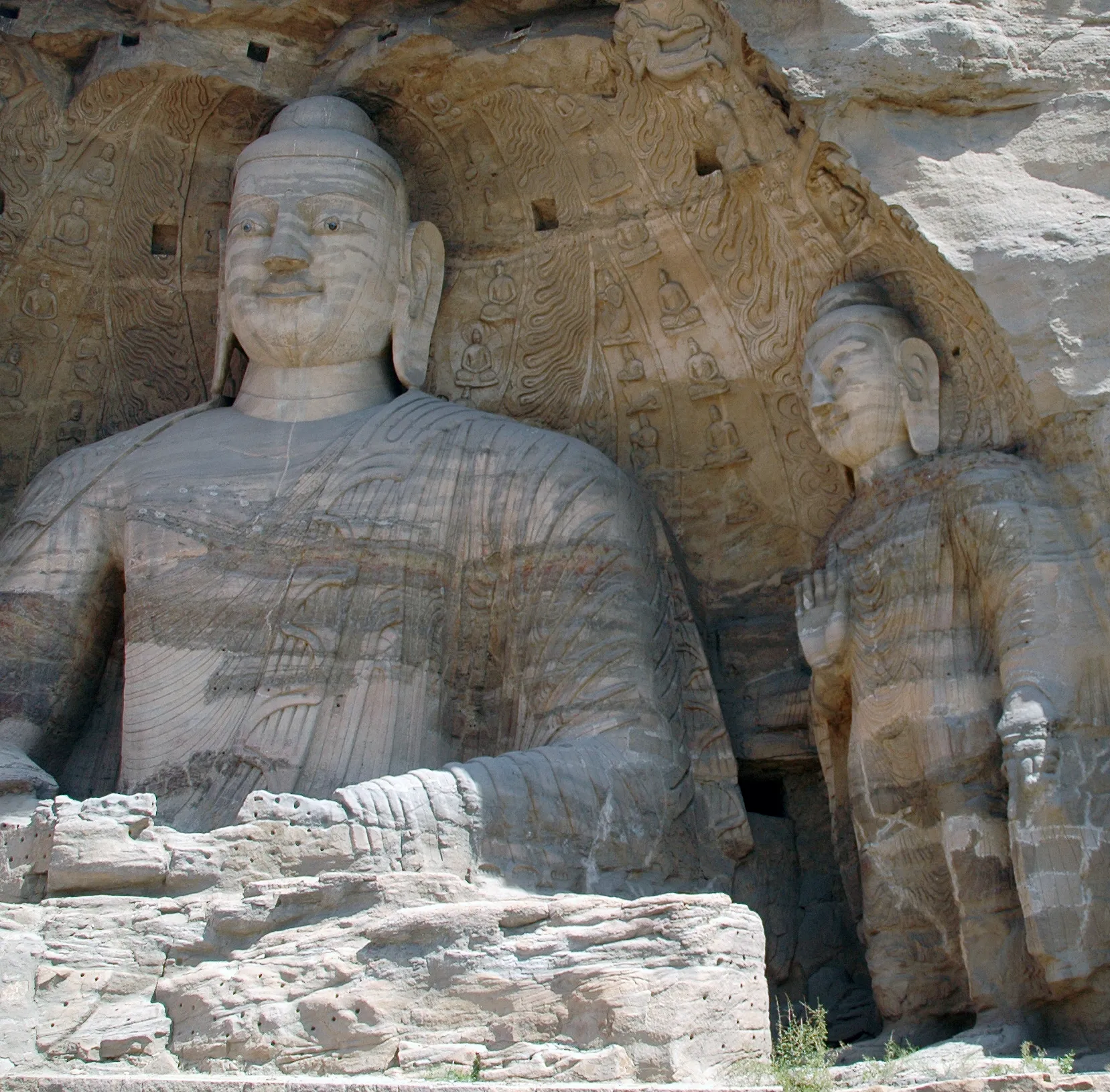
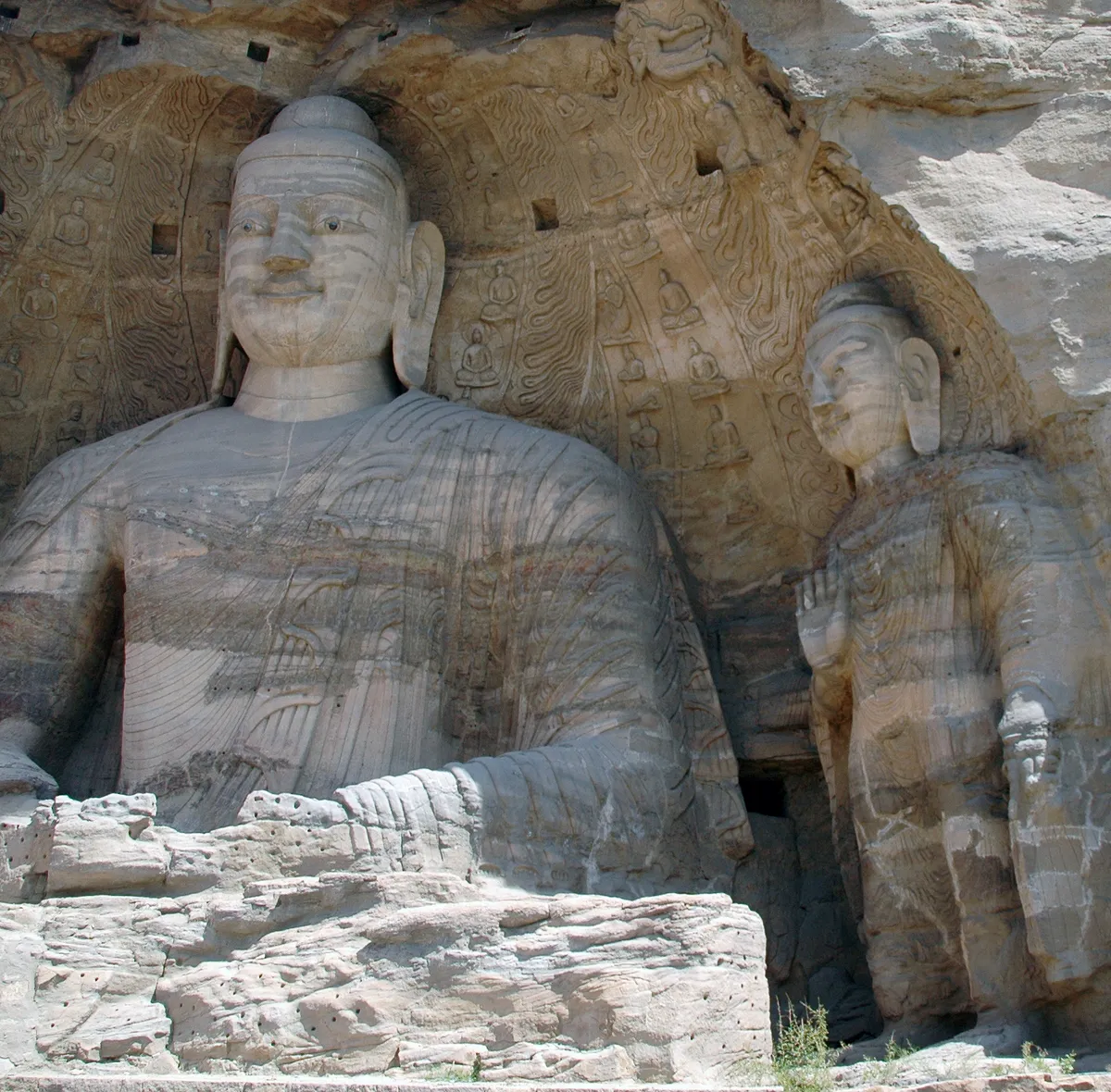
The 16.5-meter seated Great Buddha of Cave 20 at Yungang Grottoes, exposed to the open air

Destination guide · Verified 2026-07-22

Datong

Fifth-century Buddhas carved into a cliff, a temple bolted to a mountainside an hour south, and a rebuilt city wall around a quiet old town — two hours from Beijing, a world away in pace.

Getting there
High-speed rail: ~2 hr from Beijing (a genuine day-trip distance), ~2.5 hr from Pingyao via Taiyuan; Datong Yungang Airport has flights from several regional hubs
Best seasons
May–October — Datong sits on the edge of Inner Mongolia's plateau and winters are seriously cold, well below freezing
Days needed
2 days: one for Yungang Grottoes and the old town, one for the Hanging Temple (a half-day trip on its own)
Famous for
Northern Wei Buddhist cave art at Yungang, and the gravity-defying Hanging Temple an hour and a half south
Base yourself
Inside or near the old town, within the rebuilt city wall — walking distance to Huayan Temple and the Nine Dragon Screen

Datong Travel Guide: What to Know Before You Go

The short version: Datong is a two-hour high-speed rail trip from Beijing built around two sights: the Yungang Grottoes' fifth-century Buddhist cave art, and the cliff-mounted Hanging Temple an hour and a half south. Two days covers both — one for Yungang and the old town, one for the Hanging Temple.

The essentials

What to see — and what to know before you go

Nothing here needs advance booking — buy at the gate for all five sights. Verified 2026-07-22.

The 16.5-meter seated Great Buddha of Cave 20 at Yungang Grottoes, exposed to the open air

Yungang Grottoes 云冈石窟

~3.5 hours¥120 (peak season), ¥60 (low season, Nov–Mar)

252 caves and 51,000 carved Buddhist statues cut into a sandstone cliff over the 5th and 6th centuries — one of China's three great grotto sites alongside Dunhuang and Longmen. Cave 20's 16.5-meter seated Buddha, exposed since its wall collapsed centuries ago, is the single most photographed shot in Datong.

TicketsBuy at the gate or online; no advance real-name booking needed.

Local tipThe site is about 16km west of the city — budget 30-40 minutes each way by taxi or the tourist bus from the train station.
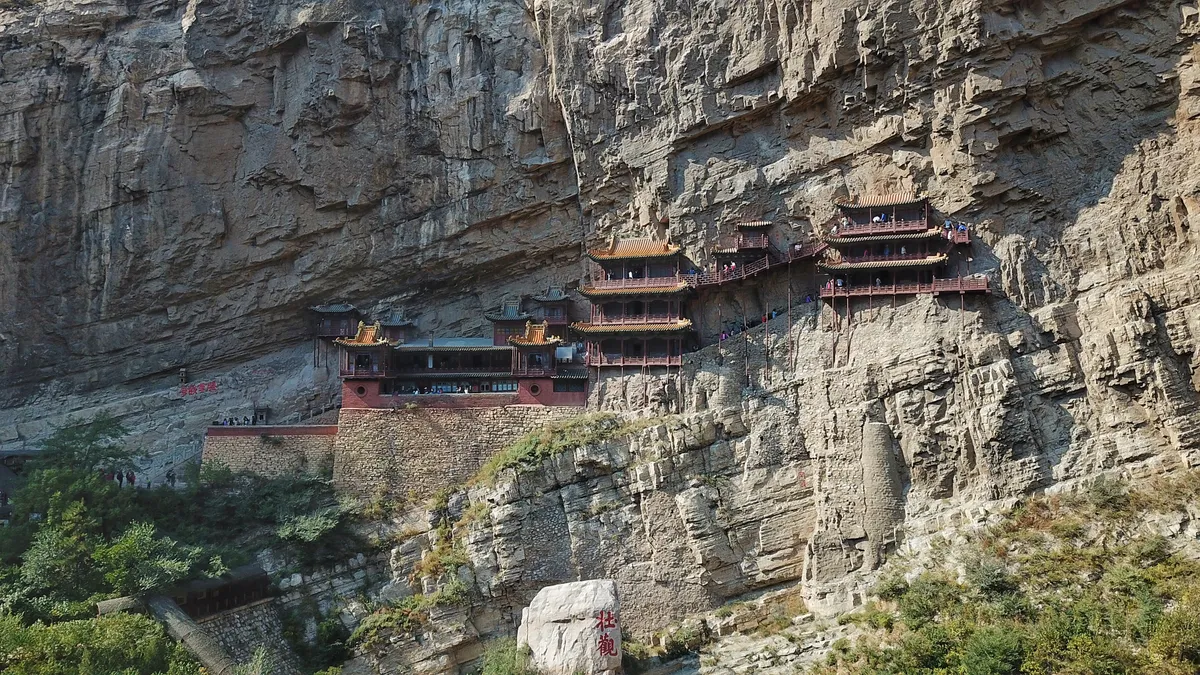
The wooden halls of the Hanging Temple bolted into a sheer cliff face on Mount Heng

Hanging Temple 悬空寺

~2.5 hours¥135 (peak season), ¥115 (low season)

A 1,500-year-old monastery bolted into a sheer cliff face on Mount Heng, its wooden halls held up by beams wedged into the rock — no visible foundation at all. About 80km southeast of Datong, making it a half-day trip in its own right, but among the most dramatic sights in China.

TicketsBuy at the gate; timed entry slots are issued on busy days to manage the narrow walkways.

Local tipThe walkways are narrow, wooden, and genuinely vertigo-inducing — it's not the place for anyone uneasy with heights or crowded platforms over a drop.

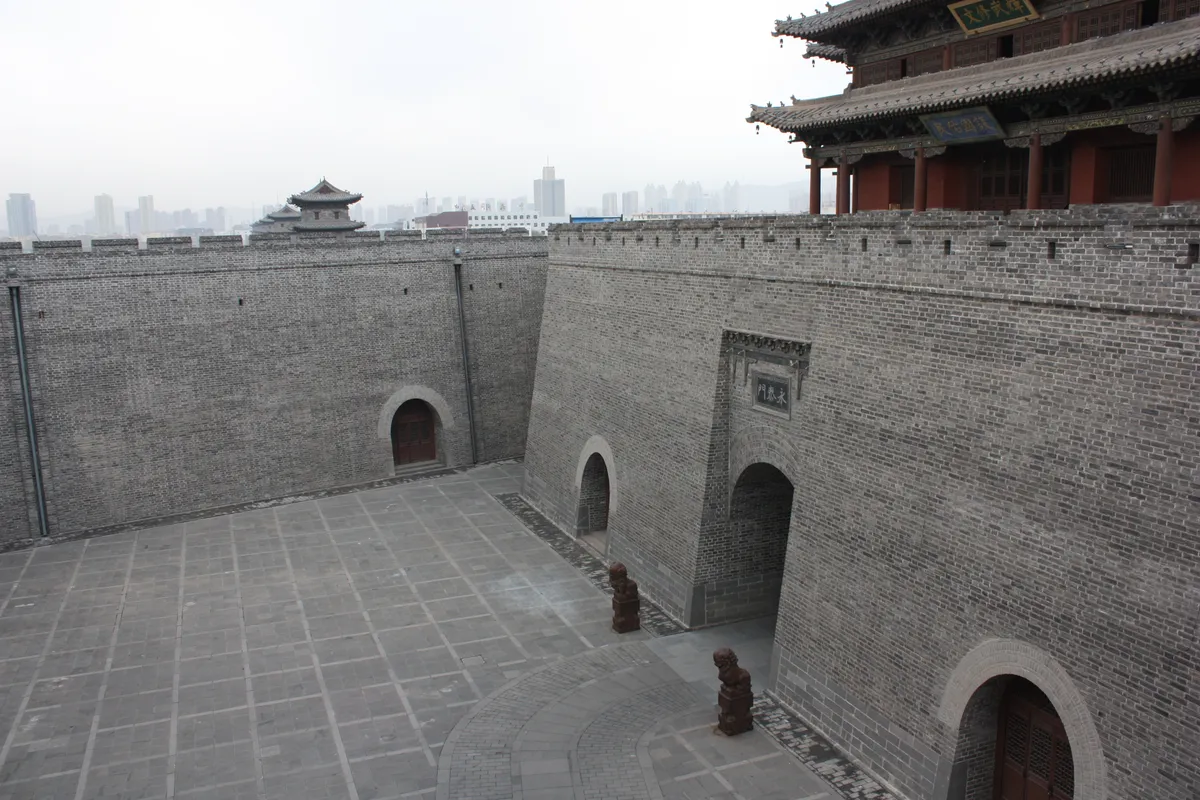
A gate tower and battlements of the rebuilt Datong city wall, with the modern skyline visible behind

Datong City Wall 大同古城墙

~2 hours¥30 (wall-top walk); some gate towers ticketed separately

A fully rebuilt Ming-dynasty wall circling the old town, wide enough to walk or cycle its full 7.2km loop with views over both the historic core and Datong's modern skyline. Less atmospheric than an original wall, but a genuinely good vantage point and orientation walk.

Local tipRenting a bike at the top makes the full loop realistic in under two hours; walking the whole thing takes considerably longer.

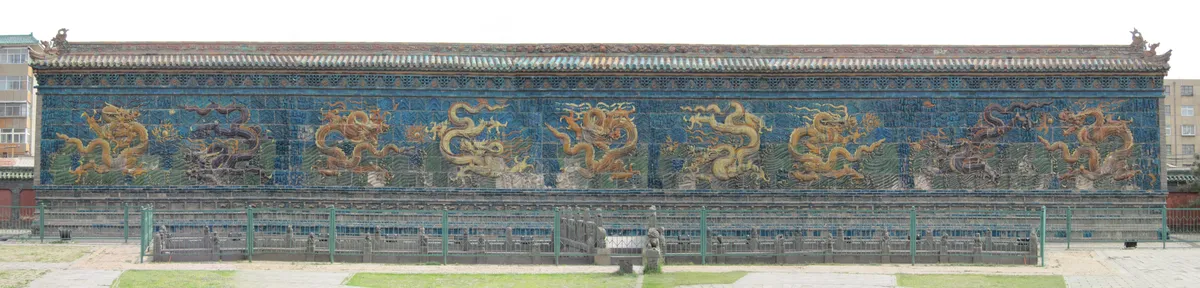
The full 45-meter glazed-tile Nine Dragon Screen in Datong, showing nine dragons across colorful ceramic panels

Nine Dragon Screen 九龙壁

~0.5 hours¥10

A 45-meter glazed-tile wall from 1392 showing nine dragons chasing pearls through waves and clouds — the largest of only four surviving Nine Dragon screens in China, and older than the one in Beijing's Forbidden City. A quick, striking stop in the old town.

Local tipIt's a short walk from the Datong City Wall's east side — easy to combine into the same afternoon.

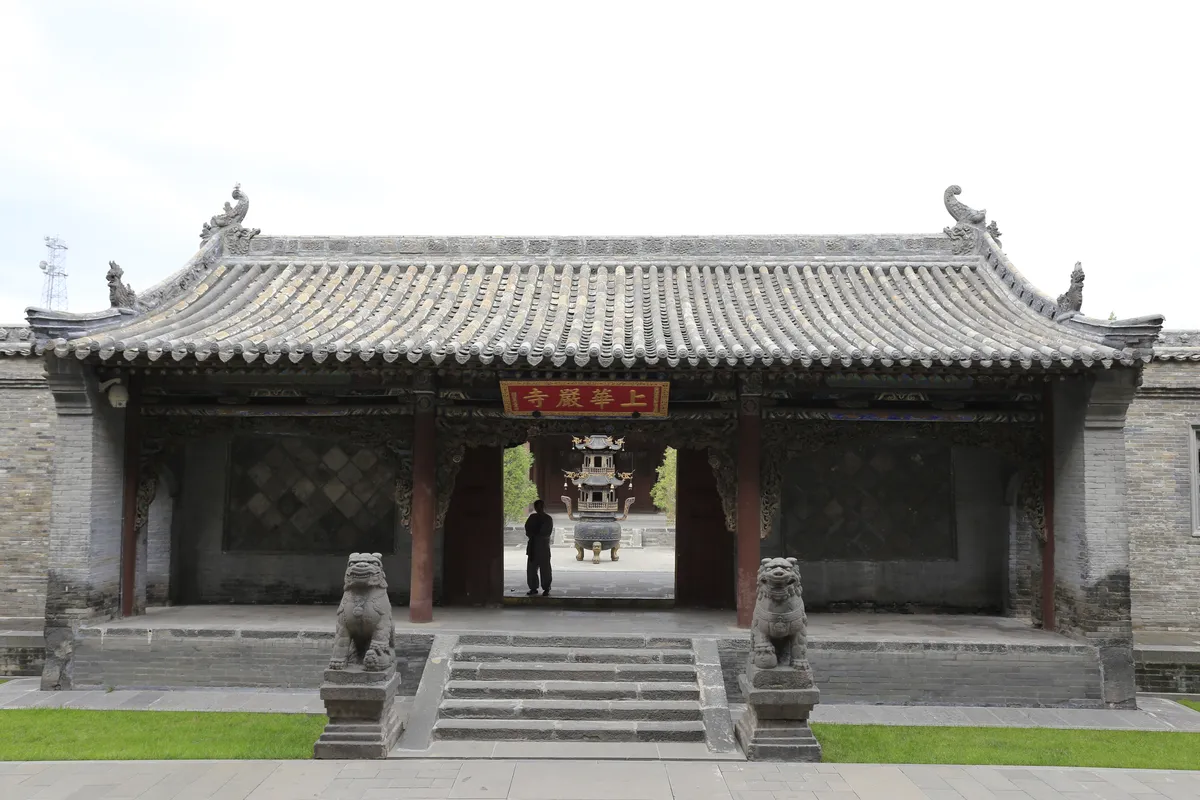
The gate of Huayan Temple in Datong, with its 'Upper Huayan Temple' plaque and stone lion guardians

Huayan Temple 华严寺

~1.5 hours¥55

A Liao and Jin dynasty temple complex built around one of China's largest surviving Buddhist halls, its main hall roofed with an enormous span of timber unusual even by imperial standards. Quieter and far less crowded than Yungang, in the middle of the old town.

Local tipCombine with the Nine Dragon Screen and city wall — all three sit within a 15-minute walk of each other in the old town.

What to eat

Datong's must-eat list

Shanxi cooking runs on hand-cut noodles and hearty, warming dishes built for cold winters. Deep dives live in our food guides; vegetarians, start here.

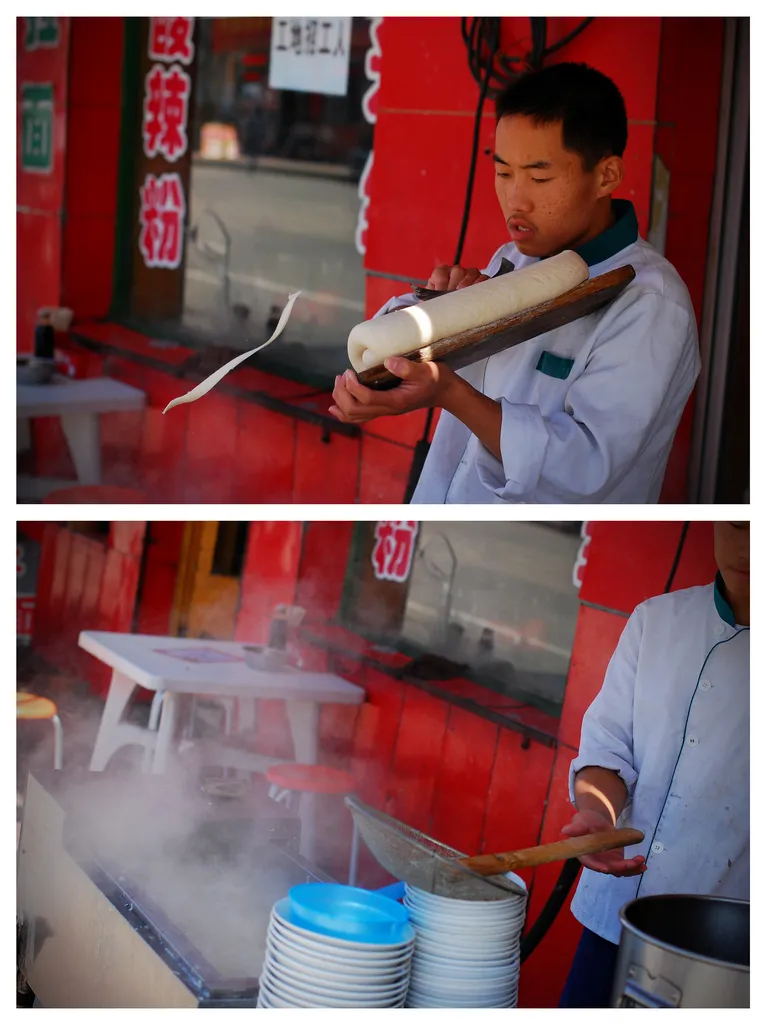
A chef shaving knife-cut noodles from a block of dough directly into a steaming pot at a Datong street stall

Knife-Cut Noodles 刀削面

Shanxi's signature noodle: a chef shaves ribbons straight off a block of dough held on the shoulder, flicking them directly into boiling water, producing thick, chewy, irregular strands unlike any machine-cut noodle. Served with tomato-egg, braised pork, or a simple vinegar-chili sauce.

WhereNoodle shops across the old town — watching the shaving technique in the window is half the reason to go

  • 🌱 vegetarian option
  • 🌾 contains gluten
  • 🌶️ mild
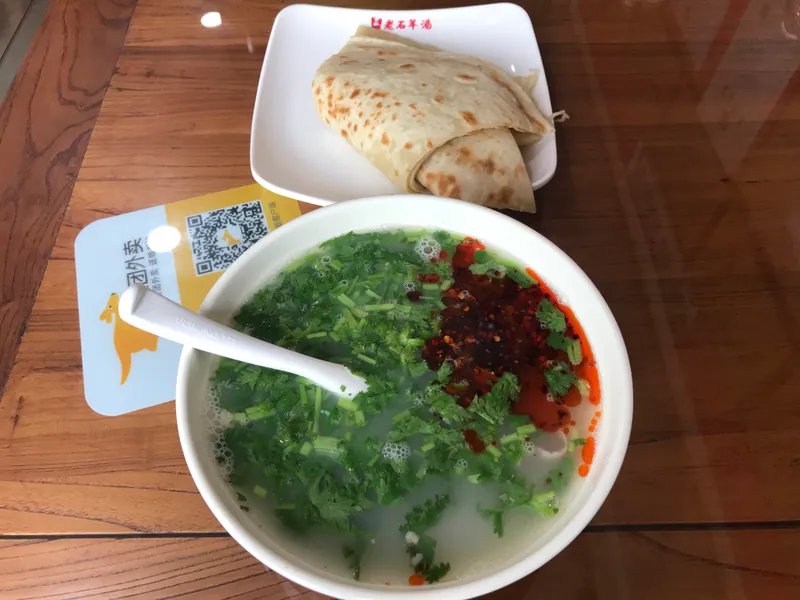
A bowl of lamb offal soup topped with cilantro and chili oil, served with a folded flatbread

Lamb Offal Soup 羊杂汤

A clear, peppery mutton broth loaded with lamb offal, finished with a heap of cilantro and chili oil, eaten with a folded sesame flatbread on the side. A cold-climate breakfast staple that fights off Datong's harsh winters better than most dishes on this site.

WhereBreakfast stalls and small shops around the old town, especially near the city wall gates

  • 🌾 contains gluten
  • 🌶️🌶️ medium

Huanggao (Fried Millet Cake) 大同黄糕

Steamed millet-flour dough, kneaded with sesame oil until smooth, then usually pinched around a bean-paste or vegetable filling and pan-fried until the outside turns golden. 'Datong has two treasures: coal and huanggao' is the local saying, and it's the first dish put in front of guests at any proper meal here.

WhereOld-town restaurants and home-style kitchens across Datong — ask for it fried (油炸) rather than plain

  • 🌱 vegetarian option

Beyond sightseeing

Experiences you can book here

Ready to plan the days?

Datong pairs naturally with Pingyao (a straightforward rail hop via Taiyuan) for a Shanxi heritage circuit, or with Beijing as a two-hour side trip. Budget a full day for Yungang and the old town, and a separate half-day for the Hanging Temple.

Placing this on the map: see where Datong sits relative to everywhere else on our interactive map of China, and check when it's busiest on the crowd calendar before you fix dates.

Frequently asked questions

Can I visit Datong as a day trip from Beijing?
Technically yes — the high-speed rail is only about 2 hours — but it's a rushed day given Yungang alone deserves half a day and the Hanging Temple is 80km further south. An overnight lets you do both without racing the clock.
Are Yungang Grottoes and the Hanging Temple in the same place?
No — Yungang is about 16km west of Datong city; the Hanging Temple is roughly 80km southeast, near Hunyuan and Mount Heng. They're usually visited on separate days or as two legs of one long day with a car and driver.
Is the Hanging Temple actually structurally hanging?
It looks unsupported from a distance, but the halls rest on wooden beams driven deep into holes carved in the cliff — a real (if startling) engineering solution, not an illusion. It's stood for roughly 1,500 years.
How cold does Datong get?
Winters are genuinely harsh — well below freezing with biting wind off the plateau. May through October is the realistic visiting window; outside that, the sights are open but the cold will shape your whole day.

Facts verified 2026-07-22. Opening rules and prices change — re-check official channels for anything booking-critical. Photos: licensed travel photography. Photo credits: Yungang Grottoes photo: Mario Biondi, CC BY-SA 2.5, via Wikimedia Commons · Hanging Temple photo: Charlie fong, CC BY-SA 4.0, via Wikimedia Commons · Datong City Wall photo: Kerryelaysahn, CC BY-SA 4.0, via Wikimedia Commons · Nine Dragon Screen photo: Jeremy Reding, CC BY-SA 2.0, via Wikimedia Commons · Huayan Temple photo: Zhangzhugang, CC BY-SA 3.0, via Wikimedia Commons · Knife-cut noodles photo: 齐健, CC BY 2.0, via Wikimedia Commons · Lamb offal soup photo: Suginami, CC BY-SA 4.0, via Wikimedia Commons · Paper-cut photo: Patricia Bjaaland Welch, CC BY-SA 3.0, via Wikimedia Commons.