Food guide · Verified 2026-08-13
How to Book a Restaurant in China (Without Speaking Chinese)
The awkward truth about reservations in China: the restaurants worth booking mostly take bookings by phone, in Chinese, and want a local number to call back. None of that requires you to speak a word of Mandarin — if you know the workarounds. Here are all five, plus the exact phrases and a note you can hand to your hotel.
First: do you actually need a reservation?
Usually not. The overwhelming majority of restaurants in China are walk-in — you show up, point at the menu, and eat. Book (or plan for a queue) in these cases:
- Famous flagships — the Peking-duck institutions in Beijing, the soup-dumpling legends in Shanghai
- High-end dining — Michelin-starred and Black Pearl (China's own fine-dining list) restaurants, often weeks ahead
- Anywhere that went viral — if it's all over social media, assume a queue
- Groups of 6+ — big round tables and private rooms (包间) go first
- Weekends and Chinese public holidays — especially Golden Week (early Oct) and Chinese New Year
Five ways to get the table
Ask your hotel front desk (the #1 method)
Chinese restaurants take bookings by phone, in Chinese, and they want a local callback number — three problems your hotel solves at once. Show the front desk the note template below, and they'll call and leave the hotel's number. Works at any hotel with a staffed desk, and hostels usually help too. Do it the morning of, or a day ahead for famous places.
Call the restaurant — or have any Chinese speaker call
If you have a guide, a local friend, or a Chinese-speaking colleague, a 30-second call settles it. Restaurants rarely speak English on the phone and almost never take bookings by email, so don't burn time hunting for a website — the phone number on their Dianping or Amap listing is the booking system. Phrases to read out (or forward) are below.
Book inside Dianping or Meituan
China's Yelp-equivalents let you book some restaurants directly: search the restaurant, and look for a 订座 (reserve) or 预订 (book) button on its page — pick a date, time, and party size. Two caveats: the apps are Chinese-only (your phone's screen-translate handles it), and registering needs a phone number that can receive SMS — a mainland number or travel eSIM with a +86 number is smoothest. Many restaurants aren't bookable online at all, which brings us to…
Take a queue number instead (取号)
Lots of popular restaurants — most famously hotpot chains like Haidilao — don't do timed reservations. You show up, take a numbered ticket from the host or a machine, and wait your turn (Haidilao famously softens the wait with snacks and manicures). Arrive at 16:30–17:00 and you'll often walk straight in; arrive at 19:00 on a Saturday and the wait can hit two hours.
Skip the reservation entirely
The reliable backup plans: eat on the dining floors of any big shopping mall (dozens of solid restaurants, seldom a serious wait), go at off-peak times (before 17:30 or after 20:30), pick a weekday lunch for that famous spot, or try a different branch of the same chain — the flagship queues, the branch two metro stops away doesn't.
How the queue actually works
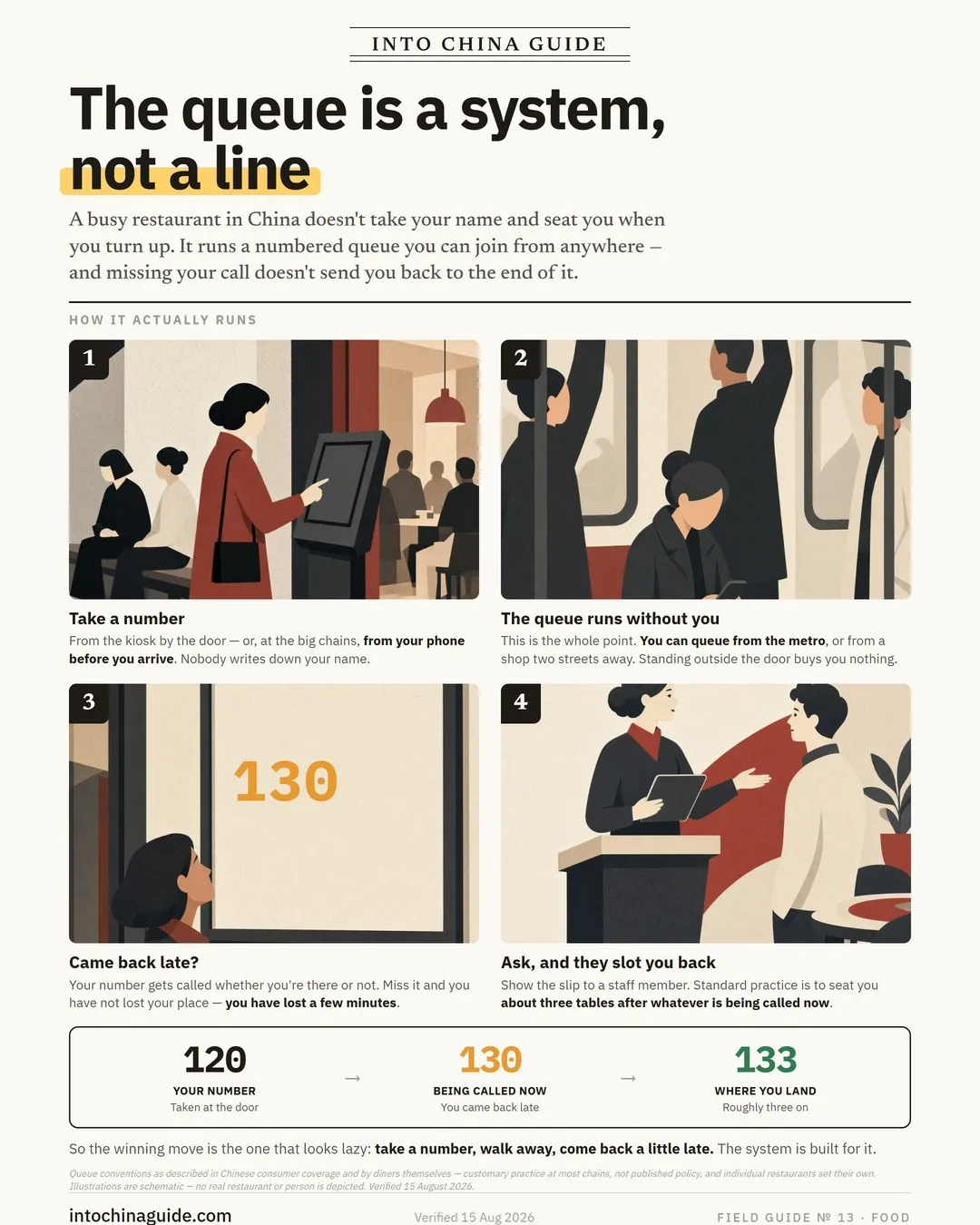
Queue numbers look chaotic from outside and are in fact a tightly run system. Three things about it are worth knowing before you're standing in a lobby holding a slip of paper you can't read.
You can often take a number before you arrive
The big chains let you join the queue remotely — through their own mini-program or official account rather than at the door. For Haidilao, the route is its official WeChat account or app: pick the branch, the party size, and take a number, then travel while the queue moves. Doing this on the metro instead of in the lobby is the single biggest time-saver available, and it's the step almost no English guide mentions.
Some of those chains also take an actual booking a half-day to a day ahead, entered with a name and phone number. Worth trying first — if the branch you want offers it, you skip the queue entirely.
Missing your number is not starting over
This is the rule that saves the evening. If your number gets called while you're outside and you come back to find the board has moved past you — 过号 — you do not go to the back of the queue. Go to the host, show your number, and you're typically slotted back in a few tables after whatever is being called now. Take number 120, come back at 130, and you'll usually be seated around 133.
Practical consequence: the wait is much more flexible than it looks. Take the number, walk the block, buy something, come back late — the system is built for exactly that.
A booked table is held, but not for long
If you reserve and then run late, expect the restaurant to call and ask whether to hold the table. Typical grace is around fifteen minutes; past that the seat goes to the queue. Since the callback number is usually your hotel's front desk, tell the desk you'll be late rather than assuming the table waits.
| On the screen or the slip | Sound | What it means |
|---|---|---|
| 取号 | qǔ hào | Take a number — the thing you do on arrival |
| 叫号 | jiào hào | The number now being called |
| 过号 | guò hào | You missed your number (not fatal — see below) |
| 等位 | děng wèi | Waiting for a table |
| 几位 | jǐ wèi | How many of you? — the first thing you'll be asked |
| 包间 | bāo jiān | Private room, usually with a minimum spend |
| 订座 / 预订 | dìng zuò / yù dìng | Reserve — the button to look for in an app |
The places that will never take your booking
Some restaurants aren't being difficult — reservations simply aren't part of how they work. Recognising the category saves you an hour of trying:
| Type | Why not |
|---|---|
| Queue-culture hotpot and barbecue | The business model is the queue. Chains build their reputation on how well they entertain you while you wait, so a table you can book defeats the point. |
| Viral tea and bakery counters | Sold by the cup or the tray, not the seat. The line is the whole transaction; some cap daily output and simply close when it's gone. |
| Small family places and hole-in-the-walls | Nobody is answering a booking line because there are three staff and all of them are cooking. Walk in, or go at an odd hour. |
| Night-market and street stalls | No table to reserve. Turnover is fast enough that the queue moves. |
For all of these, the lever isn't the booking — it's the clock. Arriving at 16:30 or after 20:30 turns a ninety-minute wait into no wait at all, and a weekday lunch does the same for a place that's impossible on Saturday night.
The note to hand your hotel front desk
Screenshot this, fill in the brackets (or just point), and any front-desk staff will know exactly what to do:
您好!麻烦帮我预订餐厅,谢谢!
餐厅名称:【 restaurant name 】
日期和时间:【 date & time 】
人数:【 how many people 】位
联系电话请留酒店前台电话。
("Hello! Could you please book a restaurant for me? Restaurant: ___, date & time: ___, party of ___. Please leave the hotel's phone number as the contact.")
Phrases for calling or at the door (screenshot these)
Pilot service
Want us to book it for you?
We're testing a free booking-help service for readers: tell us the restaurant, city, date, and party size, and we'll call and confirm the table for you, then reply by email — usually within 24 hours (China time). No charge while we pilot it.
✓ Request received!
We'll call the restaurant and email you the confirmation (or the plan B) — usually within 24 hours, China time. Check your spam folder if nothing arrives.
Frequently asked questions
- Do restaurants in China take reservations?
- Most everyday restaurants don't need one — you walk in and sit down. Reservations matter for famous flagships, high-end dining, big groups, and weekend/holiday peaks. Many popular places use a walk-in queue-ticket system (取号) instead of timed bookings.
- Can I book a restaurant without a Chinese phone number?
- Yes — the easiest route is asking your hotel front desk to call and leave the hotel's number as the contact. Booking apps like Dianping generally want a number that receives SMS in China, so a travel eSIM with a mainland number helps but isn't essential if your hotel makes the call.
- What happens if I miss my queue number in China?
- You don't lose your place. Show the number to the host and you're normally slotted back in a few tables after whatever is currently being called — take 120, return when 130 is up, and expect to be seated around 133. That flexibility is the point of the system: take the number, go for a walk, come back late. The Chinese term for it is 过号 (guò hào).
- Can I join a Chinese restaurant queue before I get there?
- At the big chains, yes, and it's the biggest time-saver on offer. Hotpot chains like Haidilao let you take a queue number remotely through their WeChat official account or app — choose the branch and party size, take the number, and travel while the queue moves. Some branches also accept an actual reservation a half-day to a day ahead, which skips the queue altogether.
- How far in advance should I book?
- Same-day or one day ahead is fine for most restaurants that take bookings. Michelin/Black Pearl restaurants and famous flagships on weekends deserve 3–7 days; top tasting-menu places can book out weeks ahead.
- Does Haidilao take reservations?
- Mostly it runs on queue numbers, but there are two shortcuts worth trying. Its WeChat official account and app let you take a queue number remotely, so you can join the line while you're still on the metro — the single most useful trick here. Some branches also accept an advance booking a half-day to a day ahead, entered with a name and phone number. Failing both, arrive before 17:00 and you'll usually walk straight in, or take a ticket and enjoy the free snacks, drinks and manicures while you wait — it's part of the experience.
- Is there an OpenTable equivalent in China?
- The closest is Dianping (大众点评) — some restaurants have a 订座 (reserve) button on their listing. But coverage is partial, the app is Chinese-only, and plenty of great restaurants still only take phone bookings, which is why the hotel-desk method remains the most reliable.
Verified 2026-08-13. App features and queue policies change; tell us if something here is out of date.