Guide · Verified 2026-08-14
China Airport Layover: Leave or Stay?
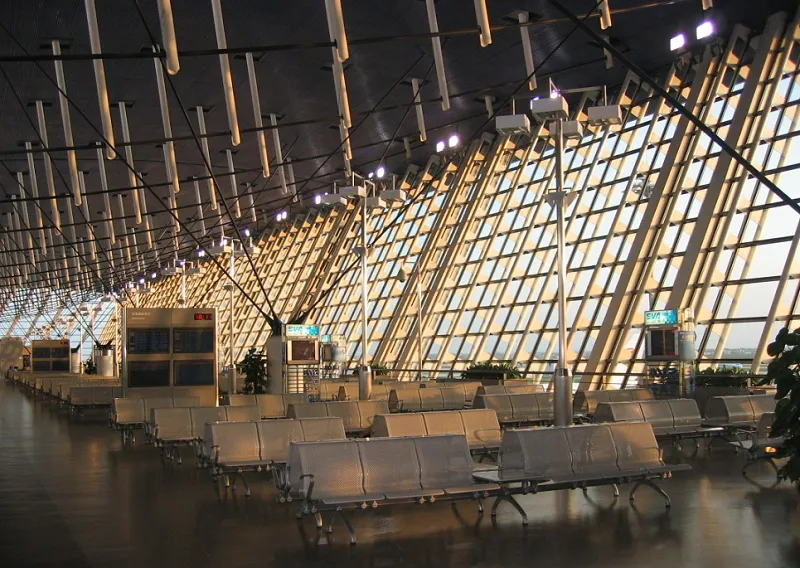
A long layover can be a free mini-trip or a tiring campout in a bright, empty terminal — and the difference is almost never the number of hours printed on your ticket. It's how much of that time survives contact with document checks, transport, and your own exhaustion. Here's the decision framework, not just the hours.
Count usable hours, not layover hours
A 9-hour layover in Xiamen is not 9 hours in Xiamen. Subtract time for deplaning, walking the terminal, document or temporary-entry checks, baggage, and finding ground transport on arrival — then subtract it all again on the way back, plus security and a buffer before boarding. What's left is your real budget, and it's usually a lot less than the number on the ticket.
The decision, by hours on the ground
| Layover length | Call | Why |
|---|---|---|
| Under 6 hours | Stay airside | Not enough usable time once you count processing and buffers both ways |
| 6–8 hours | Only a very close target | An airport hotel, a nearby mall, one simple meal — nothing that needs real transit |
| 9–12 hours | Leaving can make sense | Only if you land in daylight, travel light, and trust the transport both ways |
| 13–17 hours | One outing or one hotel — not both | Enough for a genuine half-day, or a proper sleep; trying to do both is how people miss flights |
| 18–24 hours | A real hotel + one short outing | Worth the cost of a proper bed over a bench, especially after long-haul |
Work backward from boarding, not from your printed departure time — boarding for an international flight typically starts well before wheels-up, and you want to be through security before it does. Add a delay buffer on top of whatever transit time Amap or your taxi app quotes; traffic, queues, and a language hiccup at the wrong moment eat margin fast.
Your hub's rail link — and the last train that ends the plan
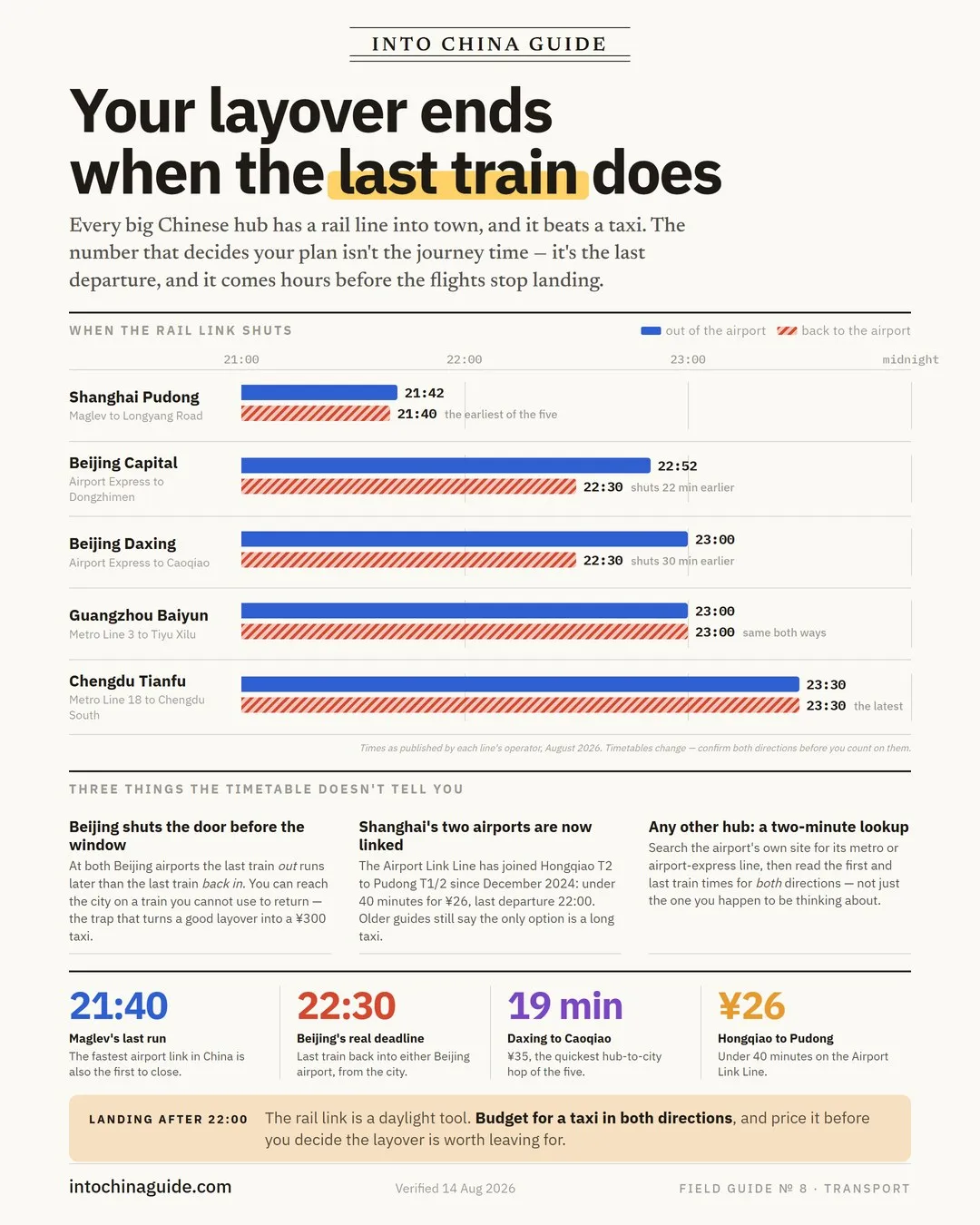
Every big Chinese hub has a rail line into town, and it is almost always faster and more predictable than a taxi. The number worth writing down isn't the journey time, though. It's the last train — because Chinese airport rail shuts between roughly 21:40 and 23:30 while international flights keep landing past midnight.
| Hub | The line into town | Last service |
|---|---|---|
| Shanghai Pudong (PVG) | Maglev to Longyang Road, then Metro Line 2 7 minutes on the maglev · ¥50, or ¥40 with a same-day air ticket | ≈21:40 out of the airport — the earliest of the five |
| Beijing Capital (PEK) | Capital Airport Express to Dongzhimen About 20–25 minutes · ¥25 | ≈22:52 out; ≈22:30 back from Dongzhimen |
| Beijing Daxing (PKX) | Daxing Airport Express to Caoqiao 19 minutes · ¥35 | ≈23:00 out; ≈22:30 back from Caoqiao |
| Guangzhou Baiyun (CAN) | Metro Line 3 north extension to Tiyu Xilu Roughly 50 minutes to the Tianhe core · standard metro fare | ≈23:00 in both directions |
| Chengdu Tianfu (TFU) | Metro Line 18 to Chengdu South Railway Station 37 minutes at its fastest · ¥11 through to Tianfu Square | ≈23:30 — the most forgiving of the five |
Two Shanghai footnotes worth having. The maglev is the fastest airport link in the country and also the earliest to close, so the novelty ride is a morning-arrival privilege. And if your layover involves both Shanghai airports — a genuinely common trap on separate tickets — the Airport Link Line has connected Hongqiao Terminal 2 to Pudong Terminal 1/2 since December 2024: under 40 minutes, ¥26, running about 06:00 to 22:39 with the last departure at 22:00 from either end. Before that line existed the answer was a long taxi ride, which is what older guides still tell you.
For any hub not in the table, the lookup takes two minutes: search the airport's own site for its metro or airport-express line, then check the first and last train times for both directions rather than the one you're thinking about. Times shift with timetable changes, so treat everything above as verified on the date at the top of this page, not as a permanent schedule.
Three layovers, on the clock
The framework above turns into a plan differently at 14, 18 and 22 hours. Each of these is built around a different mechanism, and the times are deliberately conservative — a layover plan that only works if nothing goes wrong isn't a plan.
The daylight case, where the maths actually works
- 08:00Wheels down. Deplane, walk the terminal, queue at the temporary-entry-permit counter.
- 09:15Landside with your carry-on. Assume this takes over an hour even when it doesn't.
- 09:30Maglev to Longyang Road, then Metro Line 2 or a taxi for the last stretch.
- 10:15In the city. One district, not three — the Bund and Yuyuan, or Wukang Road and the plane trees.
- 17:30Hard turnaround. Not "one more thing" — you set this time this morning for a reason.
- 18:30Back at PVG, three and a half hours before an international departure. Boring on purpose.
The overnight case, where a hotel beats a terminal bench
- 16:00Land. Clear the permit counter and collect nothing — bags checked through, ideally.
- 17:30Daxing Airport Express to Caoqiao, 19 minutes, ¥35.
- 18:15Hotel near the line, not near the sights. Tonight you are buying sleep, not location.
- 19:00Dinner and a walk. One neighbourhood on foot beats a taxi chase across the city.
- 07:00 +1Back on the airport express — first train out of Caoqiao is around 05:41, so this is comfortable.
- 07:30 +1At PKX, two and a half hours out. Daxing is enormous; that time gets used.
The case where the airline pays for the bed
- 20:00Land. If you're connecting on a China Southern ticket, find the transit desk before you do anything else.
- 20:30Free hotel room, shuttle and breakfast if your connection qualifies — see the section below.
- 09:30 +1Metro Line 3 into Tianhe, about 50 minutes. A full morning and lunch is genuinely available here.
- 15:00 +1Turn around. Line 3 back, allowing for it being a busy line at any hour.
- 16:00 +1At CAN with two hours to spare, having slept in a bed you didn't pay for.
Notice what none of them contain: a second neighbourhood, a museum with a timed ticket, or a meal booked somewhere that needs a reservation. Layover time is spent on transitions, and every extra destination is another transition. One target, done properly, is the version people remember fondly.
The free transit hotel almost nobody claims
Two Chinese airlines will put long-connection passengers in a hotel at their own expense, and the English-language internet barely mentions it. If your itinerary fits, this changes the overnight-layover calculation entirely — it converts a night on a bench into a bed, a shower, and a usable next morning.
- China Southern, at Guangzhou. For passengers connecting on the airline's own international flights — international-to-international or domestic-to-international — with a connection between 8 and 48 hours. What's provided is a single room, next-day breakfast, and free transfers between the airport and the hotel. Book it in the China Southern app or mini-program in advance (the booking window closes several hours before the Guangzhou departure), or go to the transit accommodation counter after you land.
- Xiamen Air, at Xiamen, Fuzhou, Quanzhou and Hangzhou. For domestic-to-international connections (or the reverse) of 6 to 24 hours where the two legs fall on different calendar days. You apply at the airline's transit service counter after arriving on the first leg; staff check your booking and print a hotel voucher you take to the property yourself. It's valid only for the day you land and only for the passenger named on the ticket.
Both are airline products rather than airport services, which means two things. The conditions are set by the fare and the routing, not by how long you've been awake — a self-connected itinerary on two separate tickets almost never qualifies, however long the gap. And the terms change without much announcement, so treat this as a question to ask at the transfer desk rather than a guarantee. It costs one conversation to find out, and the downside of not asking is a night in a terminal.
Overnight layovers: sleep, or a short look outside
Comfort for an overnight stay varies enormously by airport and terminal — some large hubs have 24-hour seating, lounges, capsule-style sleep pods, or nearby hourly hotels; smaller or quieter terminals can feel cold and half-lit after the last wave of flights lands. Don't plan around a specific sleep pod or shower existing — verify it's actually open the night you'll be there, ideally by calling the airport or checking recent traveler reports, not an old blog post.
If you've got 10+ overnight hours and you're eligible to leave the airport, a real hotel with 24-hour reception and a clear shuttle routine is usually worth the cost over gambling on terminal comfort — a shower and a real bed beat a bench more often than jet-lagged travelers expect going in. Check whether your airline owes you that room before you book one: the free transit hotel programmes above cover exactly this situation. Note that Chinese hotels have their own foreigner-registration routine at check-in — our hotel guide covers what to expect at 1am with a passport in hand.
Search airport hotels by the terminal name rather than the city — at Daxing or Tianfu, a place that looks close on a city map can still be forty minutes from your gate. Filter for 24-hour reception, and check the shuttle actually runs at the hour you'd land, not just "on request".Trip.com's hotel search is the English-language option most visitors end up using; it's an affiliate link, so it costs you nothing extra and helps pay for this site.
Baggage decides more than people expect
If both your flights are on a single ticket, your bag is typically checked straight through and you're free with just a carry-on — the easy case. On separate tickets, or if you're switching airlines, you may need to collect and recheck it, which adds a real chunk of time and rules out a casual trip outside. Ask at your arrival check-in counter early, and keep the baggage receipt until you've confirmed what happens next.
If you do end up holding a suitcase you don't want to drag around a city, Chinese terminals generally have a left-luggage counter —行李寄存 (xíngli jìcún) is the phrase to show or search for. Two caveats that decide whether it helps: these counters are usually landside, so they're only reachable once you've cleared immigration anyway, and their opening hours are frequently shorter than the terminal's. Confirm the closing time before you hand anything over — a bag you can't retrieve until morning is worse than a bag you carried.
Pack your carry-on as if you might be separated from your checked bag overnight:
- Charger + power bank
- Any medication you take
- Toothbrush + a clean shirt
- A warm layer (airports run cold at 3am)
- Travel documents, screenshotted, not just in the airline app
Payment and connectivity, sorted before you land
International cards work in some airport shops and hotels, not all of them — set up Alipay before you fly rather than discovering the gap at a locker or a taxi. Airport wifi can be slow or want SMS verification you can't receive; a travel eSIM sorted in advance is the difference between a relaxed meal outside and a stressful hunt for your gate later. Download offline maps and save your destination address in Chinese before you land, not after.
For transport, the airport express or metro line usually beats a taxi when it's running — no traffic, predictable stops — but first/last train times vary by city and change over time, so confirm the current schedule rather than assuming trains run as late as you'd like. Late arrivals often mean a taxi or airport bus is the only option; use the official taxi queue and have your destination written in Chinese.
Frequently asked questions
- Can I leave the airport during a China layover?
- Depends on your nationality, route, and airport — this is exactly what the 240-hour transit and visa-free rules govern. Check eligibility with our visa-free checker and transit planner before you build any plan around leaving; don't rely on a forum post or an old blog answer, since these rules have changed more than once recently.
- Is a 9-hour layover enough to see the city?
- Sometimes, but only for one simple objective. After deplaning, document checks, transport both ways, and buffers, a 9-hour layover often leaves just 3-4 usable hours outside. Pick one nearby area, set a hard turnaround time, and treat anything more ambitious as the mistake that ruins the layover.
- Can I sleep in a Chinese airport overnight?
- Often yes in some form — seating areas, lounges, and sometimes sleep pods or hourly hotels — but this varies enormously by airport and terminal and isn't something to plan around sight unseen. If you genuinely need rest, a nearby hotel with 24-hour reception is the reliable choice over gambling on terminal comfort.
- What happens to my checked bag on a long layover?
- If both flights are on one ticket, your bag is usually checked straight through and you're free to leave with just your carry-on. On separate tickets or an airline change, you'll likely need to collect and recheck it — ask at your arrival check-in counter, and keep the baggage receipt until you've confirmed the plan.
- What time does the airport train stop running in China?
- Earlier than most travellers assume, and — the part that catches people — earlier in the direction that matters. Beijing's Capital Airport Express runs out of T3 until around 22:52, but the last train from Dongzhimen back to the airport is around 22:30. Daxing is the same shape: about 23:00 out of the airport, about 22:30 back in from Caoqiao. Shanghai's maglev is the strictest at roughly 21:40. If you'd be returning to the airport after about 22:00, plan on a taxi and budget for traffic.
- Can I get a free hotel during a layover in China?
- On some tickets, yes. China Southern offers free transit accommodation in Guangzhou for passengers connecting on its own international flights with a connection between 8 and 48 hours — a single room, breakfast and airport shuttle — bookable in the airline's app in advance or at the transit counter on arrival. Xiamen Air runs a similar product in Xiamen, Fuzhou, Quanzhou and Hangzhou for domestic-to-international connections of 6 to 24 hours that fall across two calendar days. Both are airline products with conditions, not an airport service, so confirm against your own booking.
- How do I get between Shanghai's two airports on a layover?
- Since December 2024 there's a direct rail link: the Airport Link Line connects Hongqiao Terminal 2 and Pudong Terminal 1/2 in under 40 minutes for ¥26, running roughly 06:00 to 22:39 with the last departure at 22:00 from either end. That's a genuine improvement on the old metro-across-the-city option, but the 22:00 cut-off is firm — a late arrival at one airport still means a taxi to the other.
- What should I prepare before a long China layover?
- Entry eligibility confirmed, your itinerary screenshotted (not just saved in an app that needs signal), a working payment method, your destination address in Chinese, and a conservative return-to-airport time. Pack the overnight kit in your carry-on, not your checked bag. The best layover plans are boring on purpose.
Verified 2026-08-14. Rail times, fares and airline transit-hotel terms above come from operator and airline sources on that date; timetables and airline products change without much notice, so confirm anything your connection depends on. Airport-specific facilities (sleep pods, lounge access, luggage storage hours) vary and change too — check with the airport directly. Tell us if something here is out of date. Photo: WiNG, CC BY 3.0, via Wikimedia Commons.