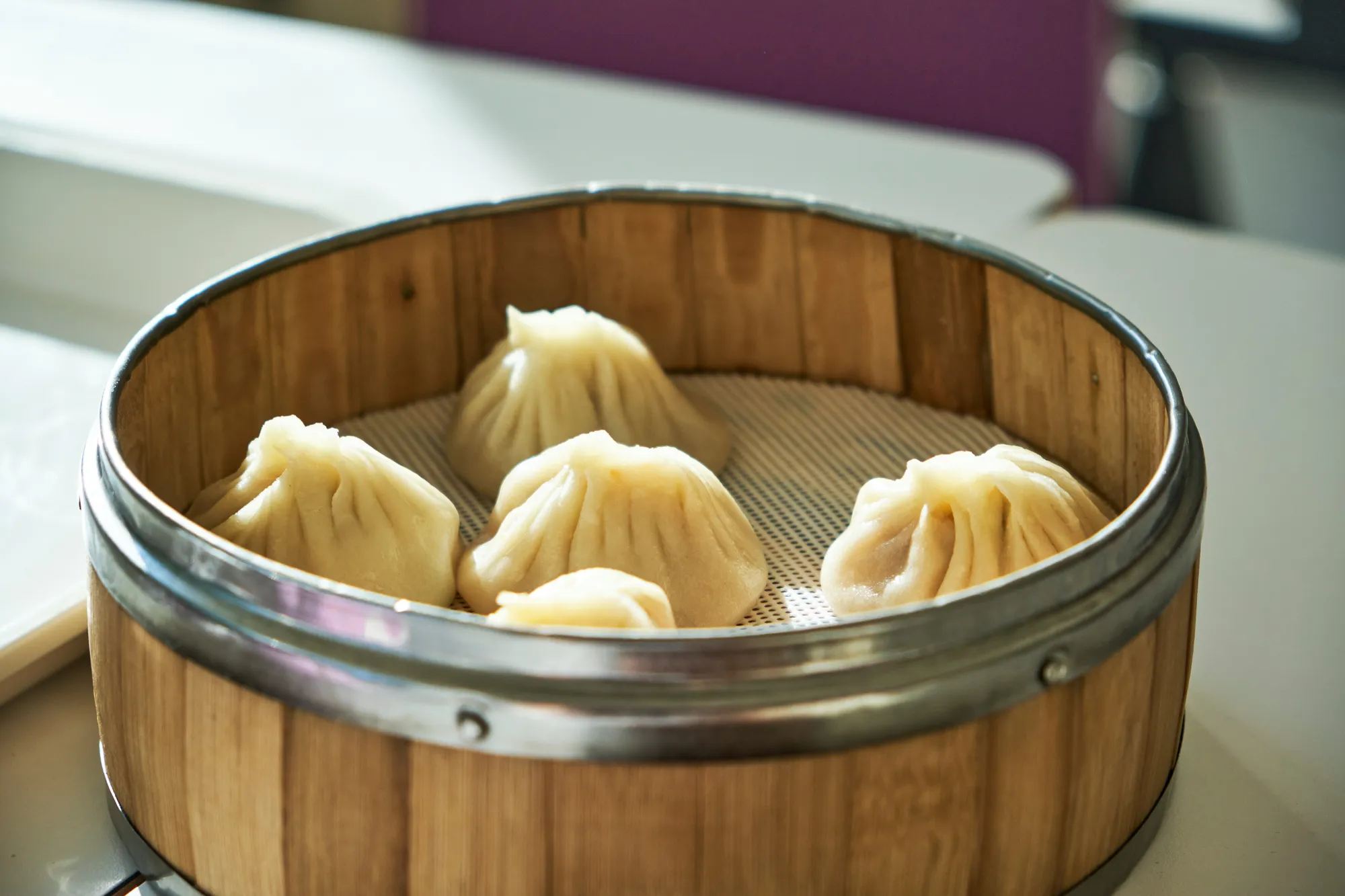
Jiǎozi (饺子) is the dumpling most people picture when they think of Chinese food: a wheat-flour wrapper crimped around a savory filling, boiled or steamed, and eaten by the dozen. It's a daily staple across northern China — cheap, fast, and endlessly customizable by filling — not a special-occasion dish, though it's the centerpiece of the Chinese New Year's Eve family meal.
How to order jiaozi
Pick your filling
Pork-and-cabbage or pork-and-chive are the classics; egg-and-chive or mushroom-and-vegetable versions cover vegetarians. Menus usually list 5-10 fillings — point at the picture if you can't read the characters.
Boiled or steamed?
Boiled (水饺, shuǐjiǎo) is the everyday default — thin skin, juicy filling, served in their own cooking water or a light broth. Steamed (蒸饺, zhēngjiǎo) has a slightly chewier skin. Pan-fried (锅贴, guōtiē) is a different dish, crisp-bottomed and closer to a potsticker.
Mix your dip
Black vinegar (陈醋, chén cù) is the standard base, often cut with a little soy sauce, chili oil, and shredded ginger — most tables have a shared bottle or a self-serve station.
Order by the liǎng, not the piece
Menus price dumplings by 半斤 (bàn jīn, ~250g, roughly 10-12 dumplings) rather than by count — a half-jin is a light meal for one, a full jin (500g) is a real dinner.
A New Year's tradition, an everyday meal
Jiaozi's shape — plump and curved — is said to resemble old silver ingots (元宝, yuánbǎo), which is why families gather to fold them together on Chinese New Year's Eve as a wish for prosperity in the coming year; some households hide a single coin inside one dumpling for whoever finds it. Outside the holiday, they're just weeknight food — neighborhood dumpling houses turn out fresh batches all day, and pre-made frozen jiaozi from any supermarket is a staple home meal across the country.
Frequently asked questions
- What is jiaozi?
- Boiled or steamed dumplings — a wheat-flour wrapper folded around a filling, most classically pork and cabbage or pork and chive. It's northern China's staple comfort food, eaten daily rather than saved for special occasions (that role belongs to jiaozi's New Year's Eve tradition specifically).
- What's the difference between jiaozi and xiaolongbao?
- Jiaozi is a thicker-skinned, pan-boiled or steamed dumpling from northern China with no soup inside. Xiaolongbao is Shanghai's soup dumpling — a thinner skin holding a pocket of hot broth, steamed in a bamboo basket. Different dough, different region, different eating technique.
- Are dumplings safe for vegetarians?
- Yes — egg-and-chive (韭菜鸡蛋, jiǔcài jīdàn) and mushroom-and-vegetable fillings are on almost every jiaozi menu, not a special request. Confirm with the server if you have a shellfish allergy, since some 'vegetable' fillings include dried shrimp for flavor.
- How much do dumplings cost?
- Cheap: a half-jin (~10-12 pieces) at a neighborhood dumpling house typically runs ¥15-25, making a full meal ¥20-30 with a side dish or soup.
- Why are dumplings eaten at Chinese New Year?
- Their shape resembles old silver ingots (元宝, yuánbǎo), so eating them at the New Year's Eve family meal is a wish for wealth in the year ahead — sometimes a family will hide a single coin inside one dumpling for good luck.
Verified 2026-07-22.