Food guide · Verified 2026-08-13
How to Order Food in China (Without Speaking Chinese)
Ordering is the one food skill worth preparing before you land. The good news: between picture menus, QR-code ordering, and translation apps, you can eat brilliantly across China without a word of Mandarin. Here's every method, the phrases to save on your phone — and, further down, how to actually read the menu, including the eight famous dish names that translate into something you'd never order.
Four ways to order
Point at the picture menu
Many casual restaurants have photo menus — laminated, on the wall, or on the table. Pointing works universally, and staff are used to it. No shame, no problem.
Scan the QR code at your table
Increasingly the default: a QR code on the table opens a digital menu in a mini-program. Some let you switch to English; most have photos. You order and often pay right there through Alipay or WeChat — no waiter needed. If it's Chinese-only, use your phone's built-in translation or the translate feature inside Alipay.
Use a translation app
Point your phone camera at a Chinese menu and translation apps overlay English in real time. It's imperfect with dish names but gets you the gist. Alipay has translation built in; download an offline pack before you travel in case data is patchy.
Show a written phrase
For allergies or restrictions, a saved screenshot of the Chinese phrase is the most reliable tool. Show it to staff rather than trying to pronounce it. Phrases below.
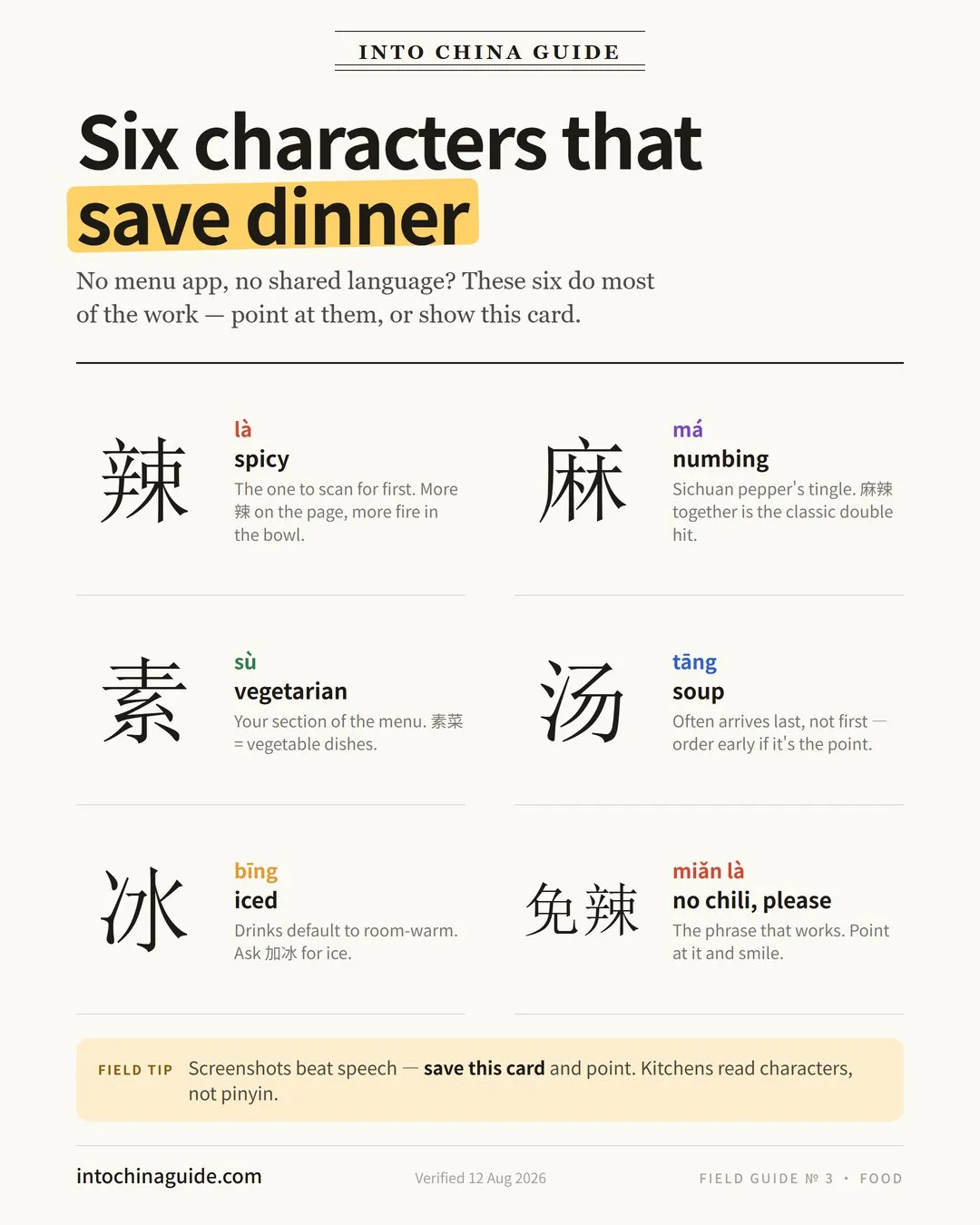
Copy-ready phrases (screenshot these)
Save this as an image on your phone. Showing the Chinese characters is far more reliable than trying to pronounce them.
Reading the menu itself
Translation apps are good at words and bad at dishes — they will cheerfully tell you a plate is called "ants climbing a tree" and leave you no wiser. The faster route is to stop translating the whole menu and learn the handful of characters that carry the decisions.
Step one: find your way around the page
Chinese menus are grouped, and the group headers are far more consistent than the dish names underneath them. Recognise these eight and you can navigate a menu you can't read:
| Characters | Sound | What it means |
|---|---|---|
| 凉菜 | liáng cài | Cold dishes — where the meal starts |
| 热菜 | rè cài | Hot dishes — the main event |
| 招牌菜 | zhāo pái cài | House specials — what they're proud of |
| 素菜 | sù cài | Vegetable dishes |
| 主食 | zhǔ shí | Staples — rice, noodles, buns |
| 汤 | tāng | Soups |
| 小吃 | xiǎo chī | Snacks and small plates |
| 饮料 | yǐn liào | Drinks |
One more worth knowing on sight: 时价 (shí jià) means "market price" — no number printed. It appears next to live seafood and premium cuts, and it is the single most common source of a bill that surprises people. Ask the price before you order anything marked that way.
Step two: the cooking word tells you what arrives
Most dish names are built as method + ingredient. Learn the method half and half the menu opens up — including one famous trap:
| Characters | Sound | What it means |
|---|---|---|
| 炒 | chǎo | Stir-fried — the everyday default |
| 蒸 | zhēng | Steamed — the gentlest thing on the menu |
| 炸 | zhá | Deep-fried |
| 烤 | kǎo | Roasted or grilled |
| 炖 / 焖 | dùn / mèn | Slow-stewed or braised |
| 凉拌 | liáng bàn | Cold-dressed, usually with garlic and vinegar |
| 水煮 | shuǐ zhǔ | Sounds like 'boiled'. It is a bowl of chili oil. |
| 干锅 | gān guō | Dry pot — served in the pan, generally spicy |
Eight dishes whose names lie to you
These are the ones that make travellers either laugh or quietly order something else. Most are excellent, and none contain what the English suggests:
鱼香肉丝
yú xiāng ròu sī
“Fish-fragrant pork slivers”
Contains no fish. The name is a Sichuan seasoning style — pickled chili, garlic, ginger, vinegar, sugar — that was first used for fish. Mildly spicy, sweet-sour, very safe.
夫妻肺片
fū qī fèi piàn
“Husband-and-wife lung slices”
Cold sliced beef and offal in chili oil. Despite the name, today's version is normally shank, tripe and tongue rather than lung.
蚂蚁上树
mǎ yǐ shàng shù
“Ants climbing a tree”
Glass noodles with minced pork. The 'ants' are the specks of pork clinging to the strands. No insects.
狮子头
shī zi tóu
“Lion's head”
A fist-sized pork meatball, usually braised. Rich and completely un-spicy — a good order when the table is on fire.
口水鸡
kǒu shuǐ jī
“Saliva chicken”
Cold poached chicken under chili oil. The name means mouth-watering, not what it looks like in English.
佛跳墙
fó tiào qiáng
“Buddha jumps over the wall”
A luxury Fujian soup of many premium ingredients, said to tempt a monk over a wall. Check the price before you point at it.
老虎菜
lǎo hǔ cài
“Tiger salad”
A raw salad of chili, coriander and spring onion. No tiger, plenty of bite.
驴打滚
lǘ dǎ gǔn
“Rolling donkey”
A Beijing dessert: glutinous rice rolled around red bean paste, dusted in soybean flour.
Scanning for what you can't eat
With an allergy or a restriction, don't read the menu — search it. Photograph the page, zoom in, and look for these shapes. Finding them is far more reliable than trusting a translation of the dish name, because ingredients often hide inside a name that mentions none of them.
| Characters | Sound | What to know |
|---|---|---|
| 花生 | huā shēng | peanut |
| 芝麻 | zhī ma | sesame |
| 坚果 | jiān guǒ | tree nuts |
| 虾 | xiā | shrimp |
| 蟹 | xiè | crab |
| 海鲜 | hǎi xiān | seafood |
| 蛋 | dàn | egg |
| 奶 | nǎi | milk / dairy |
| 猪肉 | zhū ròu | pork |
| 香菜 | xiāng cài | coriander |
| 花椒 | huā jiāo | Sichuan pepper — the numbing one |
| 味精 | wèi jīng | MSG |
For a serious allergy, characters on a menu are not enough on their own — a shared wok is a shared wok. Show the written phrase, say it matters medically, and treat street stalls with more caution than restaurants. Our dining etiquette guide covers how that conversation usually goes, and the vegetarian guide has the longer list for meat-free travel.
Frequently asked questions
- How do I read a Chinese menu without speaking Chinese?
- Stop trying to translate all of it and learn about twenty characters. The section headers (凉菜 cold dishes, 热菜 hot dishes, 主食 staples, 汤 soup) tell you where you are; the cooking word at the front of a dish name (炒 stir-fried, 蒸 steamed, 烤 grilled, 凉拌 cold-dressed) tells you what will arrive; and 辣 (spicy) and 素 (vegetarian) settle most of the rest. Watch for 时价, meaning market price with no figure printed — that's where surprise bills come from.
- Why do Chinese dish names translate so strangely?
- Because many are descriptive, historical or jokes rather than ingredient lists. 鱼香肉丝 ('fish-fragrant pork') contains no fish — the name refers to a Sichuan seasoning first used for fish. 蚂蚁上树 ('ants climbing a tree') is glass noodles with minced pork. 狮子头 ('lion's head') is a large pork meatball. A translation app renders the words correctly and the dish incorrectly, which is why a short list of the famous ones is more useful than an app.
- How do I order if the menu is only in Chinese?
- Three reliable options: use your phone camera with a translation app to overlay English, scan the table QR code (many digital menus offer an English toggle or photos), or point at what other diners are eating. Staff are patient with foreign tourists.
- What is QR-code ordering and how does it work?
- At many restaurants you scan a QR code on the table, which opens a menu in a WeChat or Alipay mini-program. You browse (often with photos), add dishes, and submit — the kitchen gets the order directly, and you usually pay in the same flow. It removes the language barrier of talking to a waiter.
- How do I tell them I can't eat spicy food?
- Show the written phrase 不要辣 (bùyào là, 'no spice') or 微辣 (wēi là, 'mild'). Note that in Sichuan and Hunan, 'mild' is still warmer than you might expect — and some classic dishes are spicy by definition.
- Do I tip at restaurants in China?
- No. Tipping isn't customary anywhere in China — not in restaurants, taxis, or hotels. The price on the menu (plus occasionally a small tea/service charge at fancier places) is what you pay.
- How do I ask for the bill?
- Say or show 买单 (mǎidān). At QR-code restaurants you often pay in the app the moment you order, so there may be no bill to ask for at all.
Verified 2026-08-13. Pinyin is a pronunciation aid, not a substitute for showing the characters. Tell us if a phrase could be clearer.